AS 1991 dawned, people were optimistic. The Cold War was over. True, there was the problem of Kuwait, which had been invaded by Iraq the previous August. But the United Nations had flexed its muscles and ordered Iraq to withdraw by January 15. The demand was being backed up by a 28-nation UN military coalition that had quickly been organized and that was poised to force Iraq into submission. Hopes were running high that the tough stand taken by the world community signaled the beginning of a new era.
George Bush, then U.S. president, spoke about “the possibility, for ourselves and for generations to come, of forging a new world order, a world in which the rule of law, and not the law of the jungle, governs international behaviour.”
Iraq subsequently ignored the January 15 deadline, and massive air and missile strikes against Iraqi military targets resulted. Clearly, the world community meant business. Less than three months later, on April 11, the UN declared the Gulf War over. The promise of a peaceful, economically and politically stable new world order seemed to be acquiring real substance.
Wars Distressingly Stable
In mid-1991 two republics, Slovenia and Croatia, declared independence from the Yugoslavia of that time, setting off a civil war that eventually led to the formation of several separate nations. Less than a year later, French political analyst Pierre Hassner said: “Like pre-1914 Europe, the new world order of George Bush died in Sarajevo.” Nevertheless, the outlook for peace brightened when talks opened in Dayton, Ohio, U.S.A., in November 1995 and a peace agreement was signed in Paris on December 14. As 1995 drew to a close, hope was revived that the new world order was perhaps not dead after all.
The republics of the Union of Soviet Socialist Republics were inching away from one another. In 1991, Lithuania, Estonia, and Latvia were the first to go, quickly followed by others. A loose grouping known as the Commonwealth of Independent States was established in December, although some former members of the Soviet Union refused to join. Then, on December 25, Gorbachev resigned as Soviet president.
However, even the individual republics began unraveling. For example, Chechnya, a small Muslim enclave in the northern Caucasus region of Russia, was striving for independence. Its attempt at secession at the end of 1994 sparked a controversial attack by Russian troops. Even though some 30,000 lives have been lost since the crisis began in the early 1990’s, the warfare has continued on into this year.
As of October 1995, between 27 and 46 conflicts—depending on how they are classified—were raging throughout the world.
On the Verge of Bankruptcy
At the start of the 1990’s, the new world order was turning out to be not only politically shaky but economically shaky as well.
In 1991, Nicaragua devalued its currency, but even then, 25 million cordobas was worth only one U.S. dollar. Meanwhile, Zaire was experiencing an inflation rate of 850 percent, forcing its citizens to endure one of the lowest living standards in the world. The Russian economy was also suffering. Inflation was running at 2,200 percent a year in 1992, making money almost worthless. Though things subsequently improved, in 1995 economic problems were far from over.
The financial scandal of the century occurred in 1991, when the Bank of Credit & Commerce International collapsed, brought down by fraud and criminal activities. Depositors in 62 lands suffered losses amounting to billions of U.S. dollars.
Not just economically weak nations were reeling; mighty Germany was weighed down by the costs of unification. Unemployment rose as workers demanded longer vacations and better health care. High absenteeism and widespread abuses of the welfare system put additional strains on the economy.
In the United States, a string of severe disasters caused havoc among insurance companies, who found themselves hard-pressed to pay insurance claims. And in 1993 the book Bankruptcy 1995: The Coming Collapse of America and How to Stop It warned of the dangers of a skyrocketing national debt and budget deficit. Even the Rock-of-Gibraltar stability of British insurer Lloyd’s of London was called into question. Battered by losses, it was being forced to think about the unthinkable—possible bankruptcy.
Religion, a Stabilizing Force?
In 1991 the German daily Frankfurter Allgemeine Zeitung remarked: “This vision of a new world order comes in a long tradition of American global views all of which have had a religious kernel and have been couched in Christian terms.”
This religious background, one would think, should have added stability to the new world order. But in actuality religious intolerance and strife led to widespread instability. Algeria and Egypt were only two of several governments at odds with Islamic fundamentalists. A wave of religiously motivated terrorism struck both countries. Religious riots in India included a nine-day period of sectarian violence in Bombay during 1993 that took more than 550 lives.
Religious disunity slowed ecumenical progress in 1994 when the Anglican Church ordained 32 women as priests. Pope John Paul II called this “a profound obstacle to every hope of reunion between the Catholic Church and the Anglican communion.”
On April 19, 1993, tension between the U.S. government and members of a religious cult, the Branch Davidians—which had already resulted in a standoff at the cult compound in Waco, Texas, and the killing of four federal agents—claimed the lives of at least 75 cult members. Two years later investigations were being made into the possibility that the terrorist bombing that killed 168 persons at a federal building in Oklahoma City might be in retaliation for the Waco attack.
The world was shocked in early 1995 to hear of a terrorist poison-gas attack in the Tokyo subway system. Ten persons died, and thousands more were sickened. The world was even more shocked when responsibility was laid at the doorstep of the apocalyptic sect called Aum Shinrikyo, or Aum Supreme Truth.
Significant Anniversaries With Little to Celebrate
In 1492, Columbus stumbled upon the Western Hemisphere. The 1992 celebration of the 500th anniversary of this event was shrouded in controversy. Some 40 million descendants of American Indians bristled at the implication that a European “discovered” lands where their ancestors had lived and flourished long before he was even born. Some called the explorer “a precursor of exploitation and conquest.” And for a fact, Columbus’ arrival in the Western Hemisphere was more a disaster than a blessing for its indigenous inhabitants. So-called Christian conquerers robbed them of their land, sovereignty, dignity, and lives.
In September 1995, Israel began a 16-month-long celebration to commemorate the 3,000th anniversary of King David’s conquest of Jerusalem. But the anniversary got off to a tragic start when Prime Minister Yitzhak Rabin was struck down on November 4 by an assassin’s bullets minutes after addressing a peace rally. This cast a shadow on the Middle East peace process, demonstrating that serious religious differences exist not only between Jews and Palestinians but even among Jews themselves.
Several 50-year anniversaries were celebrated between 1991 and 1995 in connection with World War II—the Pearl Harbor attack, which led to the entry of the United States into the war; the invasion of Europe by the Allies; the liberation of Nazi concentration camps; the Allied victory in Europe; and the dropping of the first atom bomb on Japan. In view of the blood and tears associated with these events, some people asked if they were really worth celebrating.
This led up to the anniversary of another significant event, the founding of the United Nations organization in October 1945. Hopes then ran high that the key to achieving world peace had at last been found.
The United Nations, as Boutros Boutros-Ghali, its secretary-general, recently said in its defense, has scored many triumphs. But it has not succeeded in fulfilling its charter purpose, namely “to maintain international peace and security.” Often its troops have tried to maintain peace in places where there was no peace to maintain. As of 1995, it had failed to breathe life into a shaky new world order.
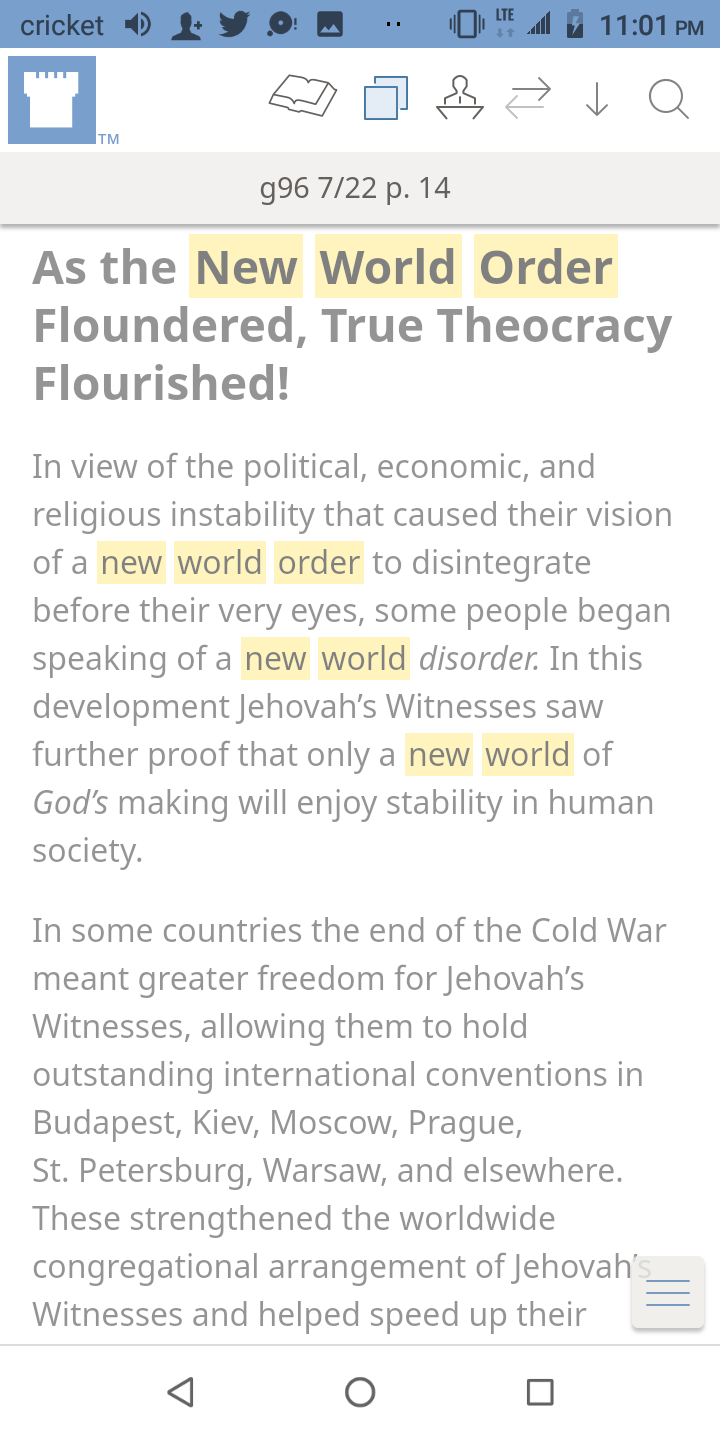
As the NewWorldOrderFloundered, True Theocracy Flourished!
In view of the political, economic, and religious instability that caused their vision of a new world order to disintegrate before their very eyes, some people began speaking of a new world disorder. In this development Jehovah’s Witnesses saw further proof that only a new world of God’s making will enjoy stability in human society.
In some countries the end of the Cold War meant greater freedom for Jehovah’s Witnesses, allowing them to hold outstanding international conventions in Budapest, Kiev, Moscow, Prague, St. Petersburg, Warsaw, and elsewhere. These strengthened the worldwide congregational arrangement of Jehovah’s Witnesses and helped speed up their preaching work. Thus, it is not surprising that the number of active Witnesses in just one of these areas grew from 49,171 in 1991 to 153,361 in 1995. During the same four years, the number of Witnesses in the entire world grew from 4,278,820 to 5,199,895. True theocracy is flourishing as never before!
Yes, millions of people now base their hopes for the future upon Jehovah God’s promise of “new heavens and a new earth” in which “righteousness is to dwell.” (2 Peter 3:10, 13) How much wiser than looking to a human new world order, which, off to a shaky start, will shortly be shaken into nonexistence!—Daniel 2:44.
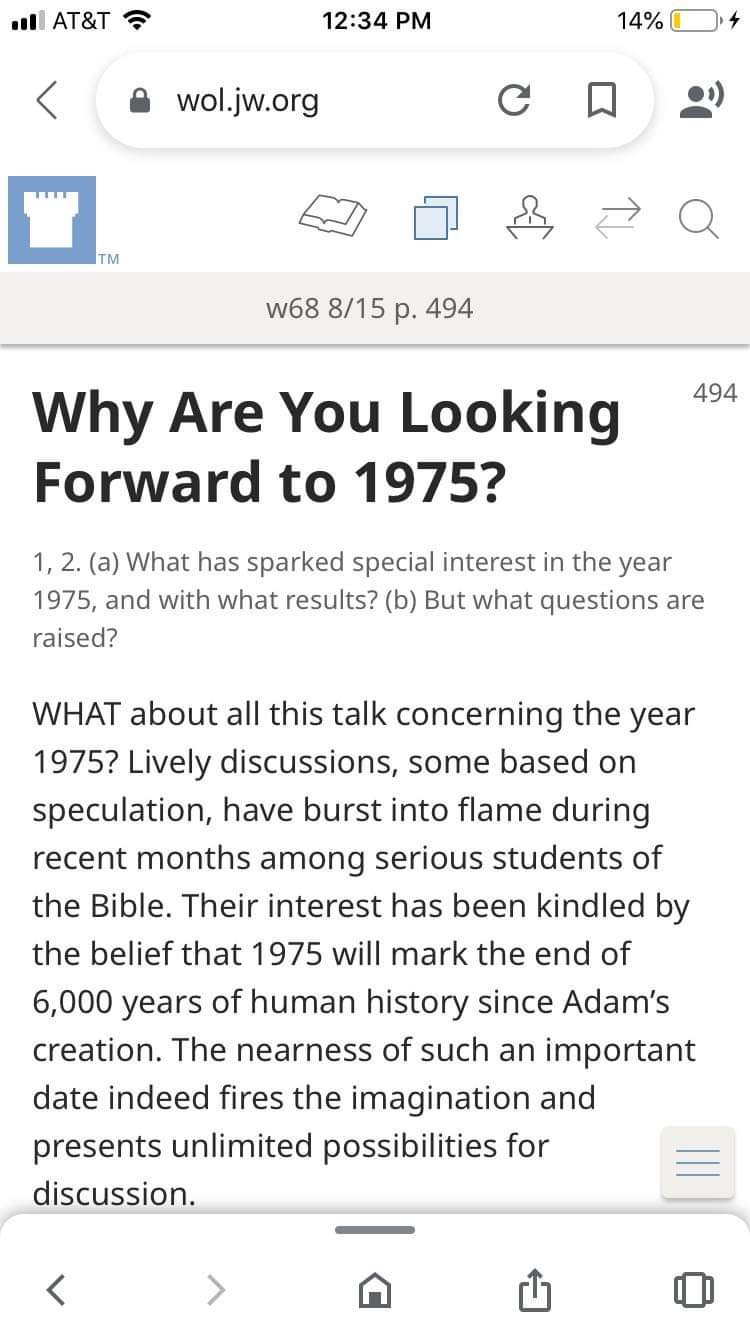
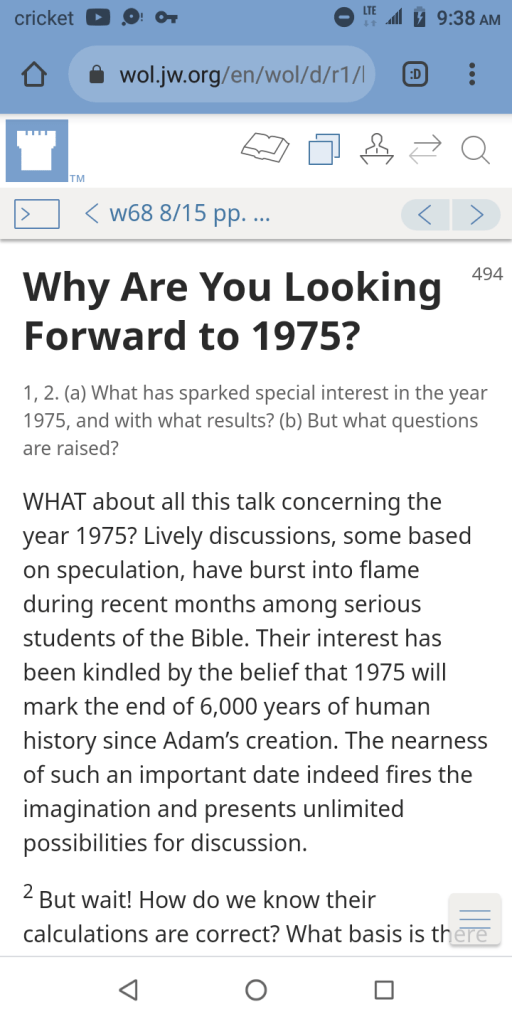
1, 2. (a) What has sparked special interest in the year 1975, and with what results? (b) But what questions are raised?
WHAT about all this talk concerning the year 1975? Lively discussions, some based on speculation, have burst into flame during recent months among serious students of the Bible. Their interest has been kindled by the belief that 1975 will mark the end of 6,000 years of human history since Adam’s creation. The nearness of such an important date indeed fires the imagination and presents unlimited possibilities for discussion.
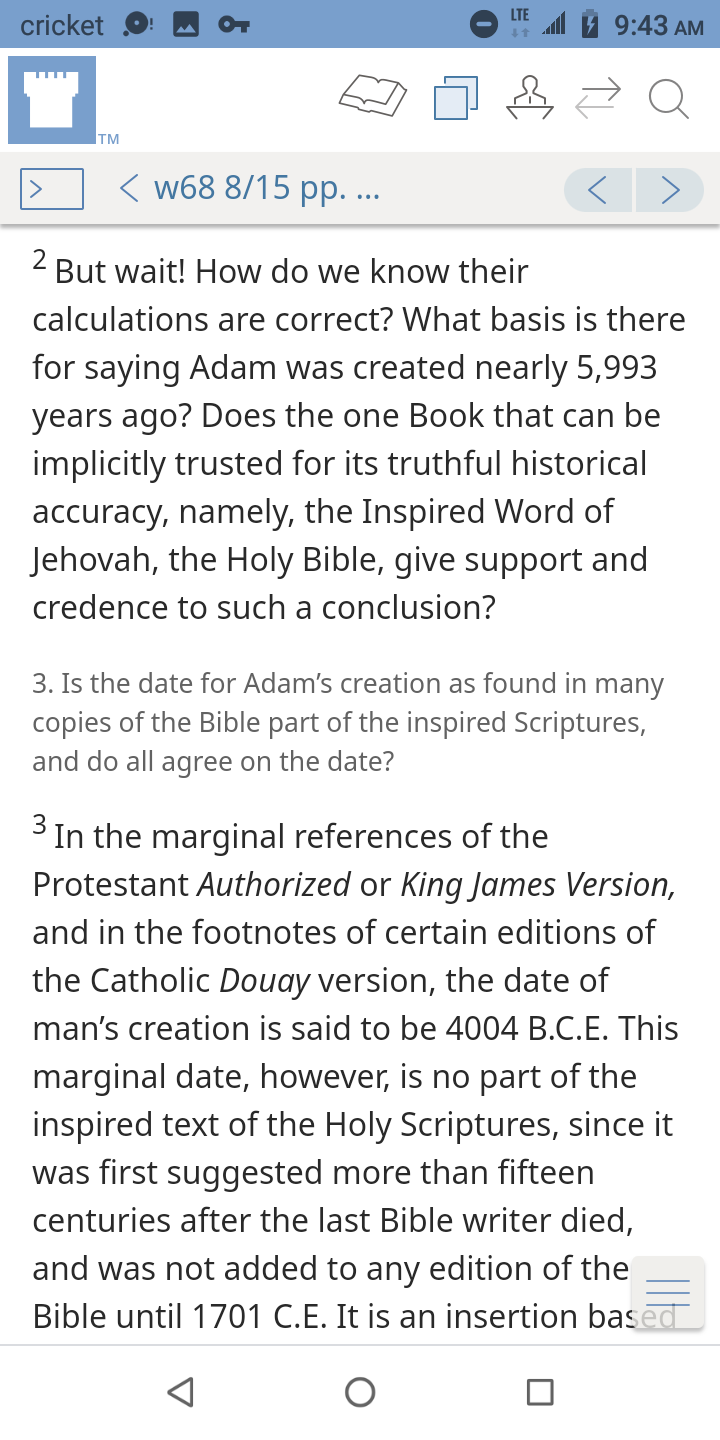
2 But wait! How do we know their calculations are correct? What basis is there for saying Adam was created nearly 5,993 years ago? Does the one Book that can be implicitly trusted for its truthful historical accuracy, namely, the Inspired Word of Jehovah, the Holy Bible, give support and credence to such a conclusion?
Is the date for Adam’s creation as found in many copies of the Bible part of the inspired Scriptures, and do all agree on the date?
3 In the marginal references of the Protestant Authorized or King James Version, and in the footnotes of certain editions of the Catholic Douay version, the date of man’s creation is said to be 4004 B.C.E. This marginal date, however, is no part of the inspired text of the Holy Scriptures, since it was first suggested more than fifteen centuries after the last Bible writer died, and was not added to any edition of the Bible until 1701 C.E. It is an insertion based upon the conclusions of an Irish prelate, the Anglican Archbishop James Ussher (1581-1656). Ussher’s chronology was only one of the many sincere efforts made during the past centuries to determine the time of Adam’s creation. A hundred years ago when a count was taken, no less than 140 different timetables had been published by serious scholars. In such chronologies the calculations as to when Adam was created vary all the way from 3616 B.C.E. to 6174 B.C.E., with one wild guess set at 20,000 B.C.E. Such conflicting answers contained in the voluminous libraries around the world certainly tend to compound the confusion when seeking an answer to the above questions.
What have we learned in our previous study, and, hence, what are we now prepared to do?
4 In the previous article we learned from the Inspired Writings themselves, independent of the uninspired marginal notes of some Bibles, that the seventy years of desolation of the land of Judah began to count about October 1, 607 B.C.E. The beginning of this seventy-year period was obviously tied to its ending, that is, with the fall of Babylon in 539 B.C.E. So with 607 B.C.E. as dependably fixed on our Gregorian calendar as the absolute date of 539 B.C.E. we are prepared to move farther back in the count of time, to the dating of other important events in Bible history. For instance, the years when Saul, David and Solomon reigned successively over God’s chosen people can now be dated in terms of the present-day calendar.
What history-making events took place in 997 B.C.E.?
5 At the death of Solomon his kingdom was split into two parts. The southern two-tribe part, composed of Judah and Benjamin, continued to be ruled by Solomon’s descendants, and was known as the kingdom of Judah. The northern ten tribes made up the kingdom of Israel, sometimes called “Samaria” after the name of its later capital city, and were ruled over by Jeroboam and his successors. By our applying the prophetic time period of 390 years found in Ezekiel 4:1-9 with regard to Jerusalem’s destruction the death of Solomon is found to be in the year 997 B.C.E. This was 390 years before the destruction of Jerusalem in 607 B.C.E.
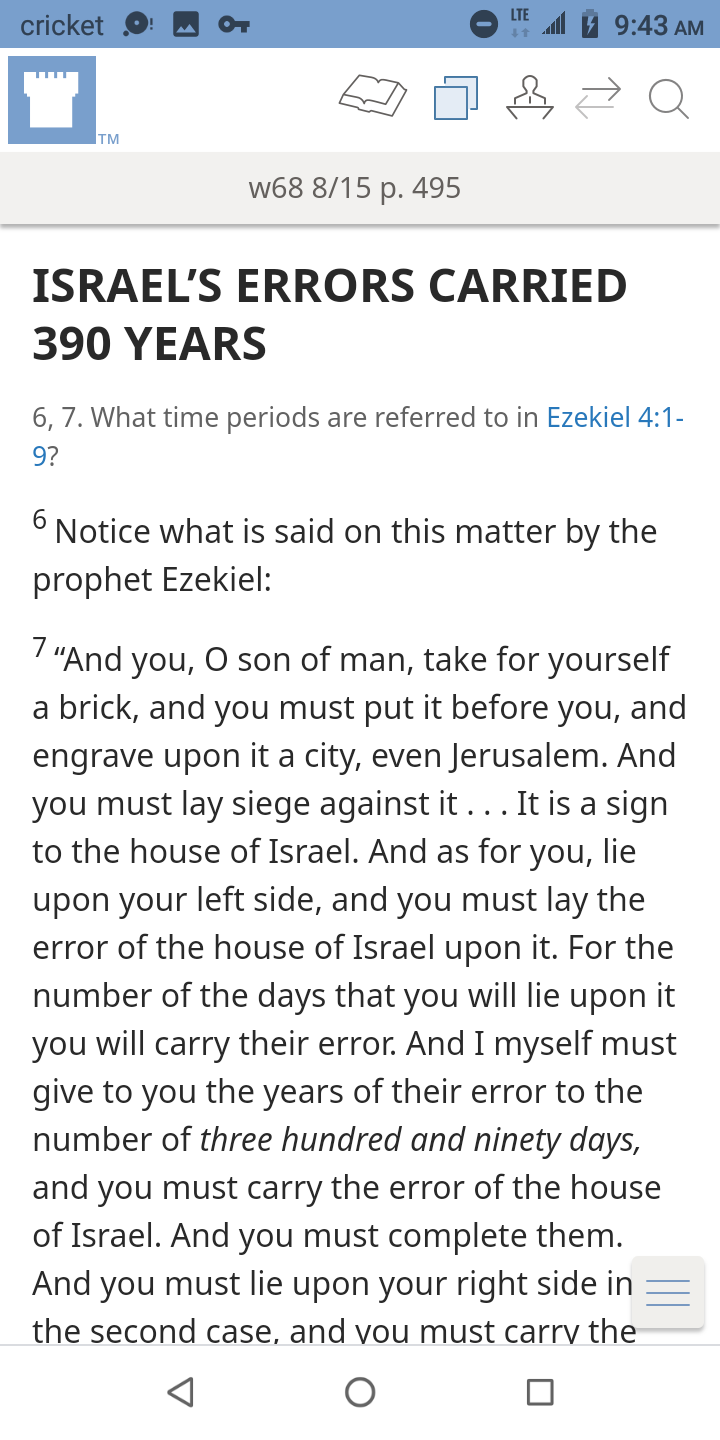
ISRAEL’S ERRORS CARRIED 390 YEARS
6, 7. What time periods are referred to in Ezekiel 4:1-9?
6 Notice what is said on this matter by the prophet Ezekiel:
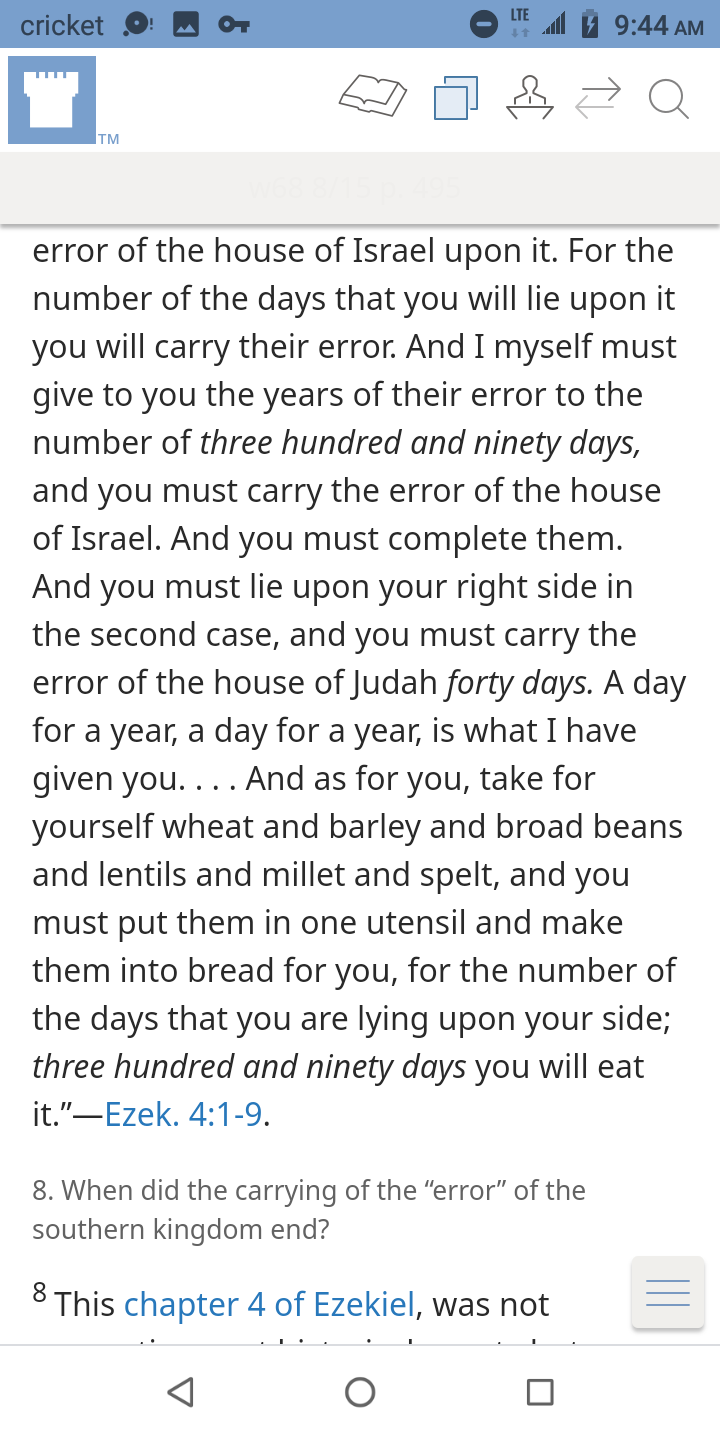
7 “And you, O son of man, take for yourself a brick, and you must put it before you, and engrave upon it a city, even Jerusalem. And you must lay siege against it . . . It is a sign to the house of Israel. And as for you, lie upon your left side, and you must lay the error of the house of Israel upon it. For the number of the days that you will lie upon it you will carry their error. And I myself must give to you the years of their error to the number of three hundred and ninety days, and you must carry the error of the house of Israel. And you must complete them. And you must lie upon your right side in the second case, and you must carry the error of the house of Judah forty days. A day for a year, a day for a year, is what I have given you. . . . And as for you, take for yourself wheat and barley and broad beans and lentils and millet and spelt, and you must put them in one utensil and make them into bread for you, for the number of the days that you are lying upon your side; three hundred and ninety days you will eat it.”—Ezek. 4:1-9.
When did the carrying of the “error” of the southern kingdom end?
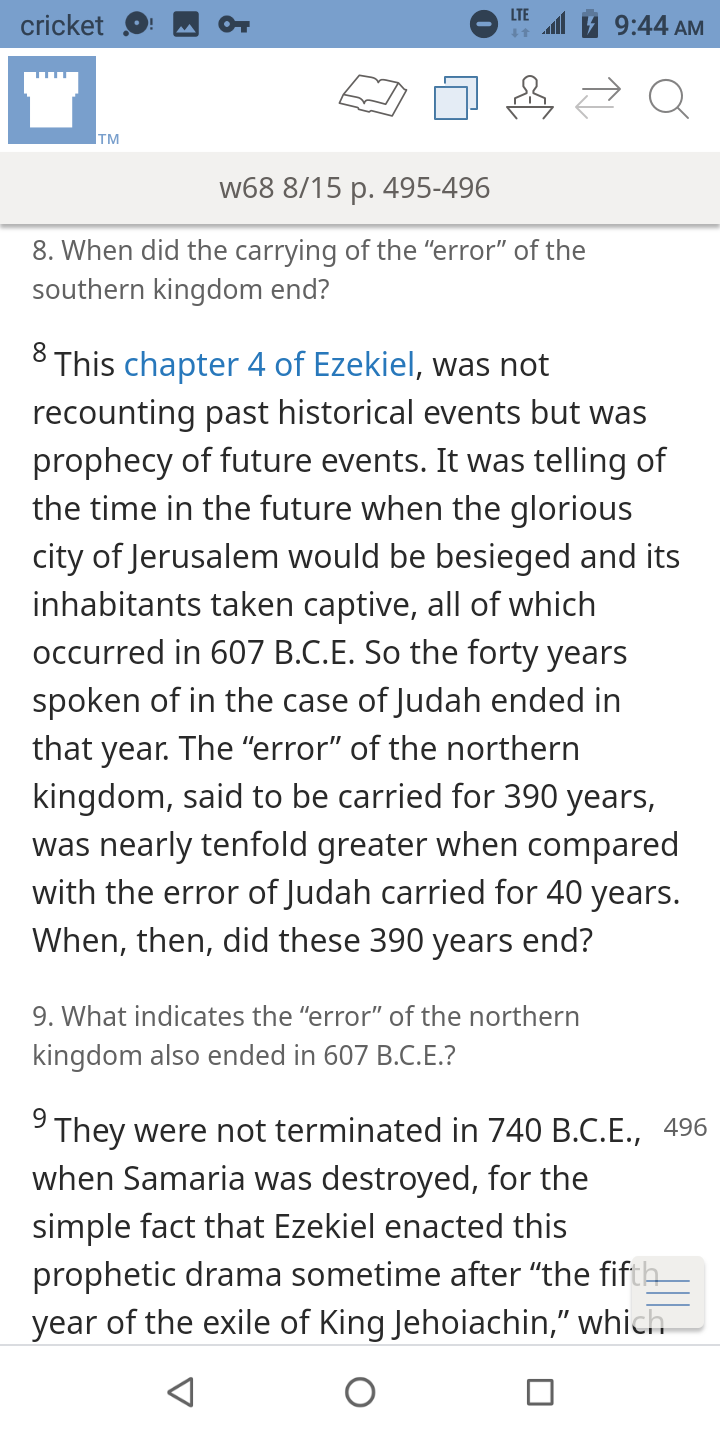
8 This chapter 4 of Ezekiel, was not recounting past historical events but was prophecy of future events. It was telling of the time in the future when the glorious city of Jerusalem would be besieged and its inhabitants taken captive, all of which occurred in 607 B.C.E. So the forty years spoken of in the case of Judah ended in that year. The “error” of the northern kingdom, said to be carried for 390 years, was nearly tenfold greater when compared with the error of Judah carried for 40 years. When, then, did these 390 years end?
What indicates the “error” of the northern kingdom also ended in 607 B.C.E.?
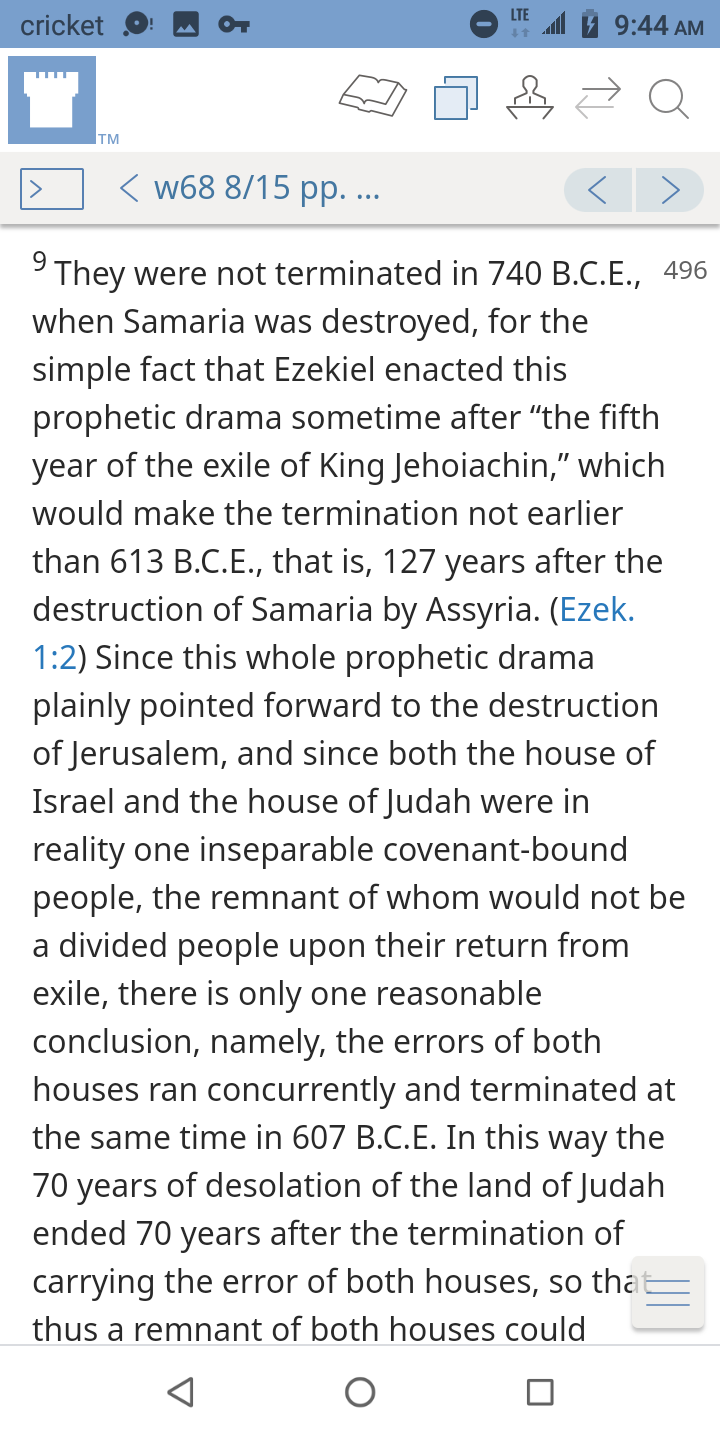
9 They were not terminated in 740 B.C.E., when Samaria was destroyed, for the simple fact that Ezekiel enacted this prophetic drama sometime after “the fifth year of the exile of King Jehoiachin,” which would make the termination not earlier than 613 B.C.E., that is, 127 years after the destruction of Samaria by Assyria. (Ezek. 1:2) Since this whole prophetic drama plainly pointed forward to the destruction of Jerusalem, and since both the house of Israel and the house of Judah were in reality one inseparable covenant-bound people, the remnant of whom would not be a divided people upon their return from exile, there is only one reasonable conclusion, namely, the errors of both houses ran concurrently and terminated at the same time in 607 B.C.E. In this way the 70 years of desolation of the land of Judah ended 70 years after the termination of carrying the error of both houses, so that thus a remnant of both houses could return to the site of Jerusalem.
So when did the “error” of Israel begin?
10 If the “error of the house of Israel” ended in 607, its beginning, 390 years prior thereto, was in 997 B.C.E. It began the year that King Solomon died and Jeroboam committed error, yes, great error, in that Jeroboam, whose domain was ripped off from the house of David, “proceeded to part Israel from following Jehovah,” causing them “to sin with a great sin.”—2 Ki. 17:21.
DATE OF EXODUS, 1513 B.C.E.
11, 12. What other event in man’s history are we now prepared to date, and with the aid of what key text?
11 Looking back into the distant past we see another milestone in man’s history, the never-to-be-forgotten exodus of the Israelites from Egyptian slavery, under the leadership of Moses. Were it not for Jehovah’s faithful Word the Bible, it would be impossible to locate this great event accurately on the calendar, for Egyptian hieroglyphics are conspicuously silent concerning the humiliating defeat handed that first world power by Jehovah. But with the Bible’s chronology, how relatively simple it is to date that memorable event!
12 At 1 Kings 6:1 we read: “And it came about in the four hundred and eightieth year after the sons of Israel came out from the land of Egypt, in the fourth year, in the month of Ziv, that is, the second month, after Solomon became king over Israel, that he proceeded to build the house to Jehovah.”
13, 14. (a) On the Gregorian calendar, in what year did Solomon begin to reign? (b) In what year did he begin the building of the temple?
13 With this information one has only to determine what calendar year Solomon began building the temple, and it is then an easy matter to figure when Pharaoh’s army was destroyed in the Red Sea.
14 “And the days that Solomon had reigned in Jerusalem over all Israel were forty years.” (1 Ki. 11:42) This means that his last full regnal year ended in the spring of 997 B.C.E.* Adding 40 to 997 gives 1037 B.C.E., the year that Solomon began his peaceful reign. He did not begin the temple building, as the account says, until the second month of the fourth year of his reign, which means he had ruled a full three years and one month. Thus subtracting 3 years from 1037 one gets 1034 B.C.E., the year that the building work began. The time of the year was the second month Ziv, that is, April-May. This, the Bible says, was “in the four hundred and eightieth year” after the Israelites left Egypt.
(a) Explain the difference between a cardinal and an ordinal number. (b) So when did the Israelites leave Egypt?
15 Anytime we put a “th” on the end of a number, for instance on the number 10, saying 10th, the number is changed from a cardinal to an ordinal number. When one speaks about playing baseball in the tenth inning of the game, it means that nine full innings have already been played, but only part of the tenth; ten innings are not yet completed. Likewise, when the Bible uses an ordinal number, saying that the building of the temple began in the 480th year after the Israelites left Egypt, and when that particular year on the calendar is known to be 1034 B.C.E., then we add 479 full years (not 480) to 1034 and arrive at the date 1513 B.C.E., the year of the Exodus. It too was springtime, Passover time, the 14th day of the month Nisan.
HOW LONG SINCE THE FLOOD?
How far back in history have we now penetrated, and what are the prospects of probing even deeper?
16 Already with the help supplied by the Bible we have accurately measured back from the spring of this year 1968 C.E. to the spring of 1513 B.C.E., a total of 3,480 years. With the continued faithful memory and accurate historical record of Jehovah’s Holy Word we can penetrate even deeper into the past, back to the flood of Noah’s day.
In recounting Israel’s experiences, to what events and to what time period does Stephen refer?
17 Stephen, the first martyred footstep follower of Jesus Christ, referred to what Jehovah said would befall Abraham’s offspring. “Moreover, God spoke to this effect, that his seed would be alien residents in a foreign land and the people would enslave them and afflict them for four hundred years.” (Acts 7:6; Gen. 15:13) Stephen here mentions three of Israel’s past experiences: As alien residents in a foreign land, as people in slavery, and as people afflicted for four hundred years.
What argues against the conclusion that these events were separate experiences following one another in consecutive order?
18 It would be a mistake to assume that all three of these experiences were of equal duration, or that they were separate individual experiences that followed one another in consecutive order. It was long after their entrance into Egypt as aliens that they were enslaved, more than 70 years later, and sometime after the death of Joseph. Rather, Stephen was saying that within the same 400-year period in which they were afflicted, they were also enslaved and were also alien residents.
How do we know the Israelites were “aliens” before entering Egypt?
19 Please note that, when Stephen said they were “alien residents in a foreign land . . . for four hundred years,” he did not say and he did not mean to imply that they were not alien residents before entering Egypt. So it is a mistake to insist that this text proves the Israelites were in Egypt for four hundred years. It is true that, upon entering Egypt and being presented before Pharaoh for the first time, Joseph’s brothers said: “We have come to reside as aliens in the land.” But they did not say nor did they mean that up until then they had not been alien residents, for on the same occasion their father Jacob, when asked by Pharaoh how old he was, declared: “The days of the years of my alien residences are a hundred and thirty years.” And not only had Jacob spent his whole lifetime as an alien resident before coming to Egypt, but he told Pharaoh that his forefathers before him also had been alien residents.—Gen. 47:4-9.
When did these 400 years end, and when did they begin?
20 Since the affliction of Israel ended in 1513 B.C.E., it must have begun in 1913, 400 years earlier. That year would correspond to the time that Isaac was afflicted by Ishmael “poking fun” at him on the day that Isaac was weaned. At the time, Isaac was five years old, and this was long before the Israelites entered Egypt.—Gen. 21:8, 9.
21, 22. Were the Israelites 430 years in Egypt exclusively, and how do certain ancient manuscripts shed light on this point?
21 Well, then, how long were the Israelites down in Egypt as alien residents? Exodus 12:40, 41 says: “And the dwelling of the sons of Israel, who had dwelt in Egypt, was four hundred and thirty years. And it came about at the end of the four hundred and thirty years, it even came about on this very day that all the armies of Jehovah went out of the land of Egypt.”
22 Here Ex 12 verse 40 in the Septuagint reads: “But the dwelling of the sons of Israel which they [and their fathers, Alexandrine MS] dwelt in the land of Egypt AND IN THE LAND OF CANAAN [was] four hundred and thirty years long.” The Samaritan Pentateuch reads: “IN THE LAND OF CANAAN and in the land of Egypt.” Thus both of these versions, which are based on Hebrew texts older than the Masoretic, include the words “in the land of Canaan” together with the word “Egypt.”
(a) So how long were the Israelites actually in Egypt, and how does Paul confirm this? (b) Explain the difference between the 400 and the 430 years mentioned in the Scriptures.
23 From the time that Abraham entered Canaan until Isaac’s birth was 25 years;* from that time until Jacob’s birth, 60 more years; and after that it was another 130 years before Jacob entered Egypt. All together this makes a total of 215 years, exactly half of the 430 years, spent in Canaan before moving in to Egypt. (Gen. 12:4; 21:5; 25:26; 47:9) The apostle Paul, under inspiration, also confirms that from the making of the Abrahamic covenant at the time the patriarch moved into Canaan, it was 430 years down to the institution of the Law covenant.—Gal. 3:17.
24, 25. The Flood began in what calendar year, and how long was this before Abraham entered Canaan?
24 By adding this 430 years to the 1513 it puts us back to 1943 B.C.E., the time when Abraham first entered Canaan following the death of his father Terah in Haran, Mesopotamia. It is now only a matter of adding up the years of a few generations to date the Flood correctly. The figures are given in Genesis, chapters 11 and 12, and may be summarized as follows:
From start of Flood
To Arpachshad’s birth (Gen. 11:10) 2 years
To birth of Shelah (11:12) 35 “
To birth of Eber (11:14) 30 “
To birth of Peleg (11:26) 34 “
To birth of Reu (11:18) 30 “
To birth of Serug (11:20) 32 “
To birth of Nahor (11:22) 30 “
To birth of Terah (11:24) 29 “
To death of Terah in Haran, and
Abram’s departure to Canaan
at age of 75 (11:32; 12:4) 205 “
Total 427 years
25 Adding these 427 years to the year 1943 B.C.E. dates the beginning of the Deluge at 2370 B.C.E., 4,337 years ago.
6,000 YEARS FROM ADAM’S CREATION
26, 27. (a) How long before the Flood was Adam created? In what year? (b) What indicates that Adam was created in the fall of the year?
26 In a similar manner it is only necessary to add up the following years involving ten pre-Flood generations to get the date of Adam’s creation, namely:
From Adam’s creation
To birth of Seth (Gen. 5:3) 130 years
To birth of Enosh (5:6) 105 “
To birth of Kenan (5:9) 90 “
To birth of Mahalalel (5:12) 70 “
To birth of Jared (5:15) 65 “
To birth of Enoch (5:18) 162 “
To birth of Methuselah (5:21) 65 “
To birth of Lamech (5:25) 187 “
To birth of Noah (5:28, 29) 182 “
To beginning of Flood (7:6) 600 “
Total 1,656 years
27 Adding this figure 1,656 to 2,370 gives 4026 B.C.E., the Gregorian calendar year in which Adam was created. Since man naturally began to count time with his own beginning, and since man’s most ancient calendars started each year in the autumn, it is reasonable to assume that the first man Adam was created in the fall of the year.
How does this chronology differ from Ussher’s in regard to Adam’s creation?
28 Thus, through a careful independent study by dedicated Bible scholars who have pursued the subject for a number of years, and who have not blindly followed some traditional chronological calculations of Christendom, we have arrived at a date for Adam’s creation that is 22 years more distant in the past than Ussher’s figure. This means time is running out two decades sooner than traditional chronology anticipates.
Why be concerned with the date of Adam’s creation?
29 After much of the mathematics and genealogies, really, of what benefit is this information to us today? Is it not all dead history, as uninteresting and profitless as walking through a cemetery copying old dates off tombstones? After all, why should we be any more interested in the date of Adam’s creation than in the birth of King Tut? Well, for one thing, if 4,026 is added to 1,968 (allowing for the lack of a zero year between C.E. and B.C.E.) one gets a total of 5,993 years, come this autumn, since Adam’s creation. That means, in the fall of the year 1975, a little over seven years from now (and not in 1997 as would be the case if Ussher’s figures were correct), it will be 6,000 years since the creation of Adam, the father of all mankind!
ADAM CREATED AT CLOSE OF “SIXTH DAY”
What may occur before 1975, but what attitude should we take?
30 Are we to assume from this study that the battle of Armageddon will be all over by the autumn of 1975, and the long-looked-for thousand-year reign of Christ will begin by then? Possibly, but we wait to see how closely the seventh thousand-year period of man’s existence coincides with the sabbathlike thousand-year reign of Christ. If these two periods run parallel with each other as to the calendar year, it will not be by mere chance or accident but will be according to Jehovah’s loving and timely purposes. Our chronology, however, which is reasonably accurate (but admittedly not infallible), at the best only points to the autumn of 1975 as the end of 6,000 years of man’s existence on earth. It does not necessarily mean that 1975 marks the end of the first 6,000 years of Jehovah’s seventh creative “day.” Why not? Because after his creation Adam lived some time during the “sixth day,” which unknown amount of time would need to be subtracted from Adam’s 930 years, to determine when the sixth seven-thousand-year period or “day” ended, and how long Adam lived into the “seventh day.” And yet the end of that sixth creative “day” could end within the same Gregorian calendar year of Adam’s creation. It may involve only a difference of weeks or months, not years.
What do the first two chapters of Genesis disclose?
31 In regard to Adam’s creation it is good to read carefully what the Bible says. Moses in compiling the book of Genesis referred to written records or “histories” that predated the Flood. The first of these begins with Genesis 1:1 and ends at Genesis 2:4 with the words, “This is the history of the heavens and the earth . . . ” The second historical document begins with Genesis 2:5 and ends with Ge verse two of chapter five. Hence we have two separate accounts of creation from slightly different points of view. In the second of these accounts, in Genesis 2:19, the original Hebrew verb translated “was forming” is in the progressive imperfect form. This does not mean that the animals and birds were created after Adam was created. Genesis 1:20-28 shows it does not mean that. So, in order to avoid contradiction between Ge chapter one and chapter two, Genesis 2:19, 20 must be only a parenthetical remark thrown in to explain the need for creating a “helper” for man. So the progressive Hebrew verb form could also be rendered as “had been forming.”—See Rotherham’s translation (Ro), also Leeser’s (Le).
What indicates the sixth creative day did not end immediately with Adam’s creation?
32 These two creation accounts in the book of Genesis, though differing slightly in the treatment of the material, are in perfect agreement with each other on all points, including the fact that Eve was created after Adam. So not until after this event did the sixth creative day come to an end. Exactly how soon after Adam’s creation is not disclosed. “After that [Adam and Eve’s creation] God saw everything he had made and, look! it was very good. And there came to be evening and there came to be morning, a sixth day.” (Gen. 1:31) After the sixth creative day ends, the seventh one begins.
(a) How do we know the end of the sixth creative day came very soon after Adam’s creation? (b) How does Genesis 1:31 prove the sixth day ended before Adam and Eve sinned?
33 This time between Adam’s creation and the beginning of the seventh day, the day of rest, let it be noted, need not have been a long time. It could have been a rather short one. The naming of the animals by Adam, and his discovery that there was no complement for himself, required no great length of time. The animals were in subjection to Adam; they were peaceful; they came under God’s leading; they were not needing to be chased down and caught. It took Noah only seven days to get the same kinds of animals, male and female, into the Ark. (Gen. 7:1-4) Eve’s creation was quickly accomplished, ‘while Adam was sleeping.’ (Gen. 2:21) So the lapse of time between Adam’s creation and the end of the sixth creative day, though unknown, was a comparatively short period of time. The pronouncement at the end of the sixth day, “God saw everything he had made and, look! it was very good,” proves that the beginning of the great seventh day of the creative week did not wait until after Adam and Eve sinned and were expelled from the Garden of Eden.
1975! . . . AND FAR BEYOND!
What has brought about a better understanding of Bible chronology?
34 Bible chronology is an interesting study by which historic events are placed in their order of occurrence along the stream of time. The Watch Tower Society over the years has endeavored to keep its associates abreast with the latest scholarship that proves consistent with historic and prophetic events recorded in the Scriptures. Major problems in sacred chronology have been straightened out either due to fulfillment of Bible prophecies or by reason of archaeological discoveries or because better Bible translations convey more clearly the records of the original languages. However, several knotty problems of chronology of a minor nature are not yet resolved. For example, at the time of the exodus from Egypt when Jehovah changed the beginning of the year from autumn time on the secular calendar to spring time on the sacred calendar, was there, in the Jewish calendar, a loss or a gain of six months?—Ex. 12:1, 2.
Why is this no time for indifference and complacency?
35 One thing is absolutely certain, Bible chronology reinforced with fulfilled Bible prophecy shows that six thousand years of man’s existence will soon be up, yes, within this generation! (Matt. 24:34) This is, therefore, no time to be indifferent and complacent. This is not the time to be toying with the words of Jesus that “concerning that day and hour nobody knows, neither the angels of the heavens nor the Son, but only the Father.” (Matt. 24:36) To the contrary, it is a time when one should be keenly aware that the end of this system of things is rapidly coming to its violent end. Make no mistake, it is sufficient that the Father himself knows both the “day and hour”!
What helpful example did the apostles leave us in this regard?
36 Even if one cannot see beyond 1975, is this any reason to be less active? The apostles could not see even this far; they knew nothing about 1975. All they could see was a short time ahead in which to finish the work assigned to them. (1 Pet. 4:7) Hence, there was a ring of alarm and a cry of urgency in all their writings. (Acts 20:20; 2 Tim. 4:2) And rightly so. If they had delayed or dillydallied and had been complacent with the idea the end was some thousands of years off they would never have finished running the race set before them. No, they ran hard and they ran fast, and they won! It was a life or death matter with them.—1 Cor. 9:24; 2 Tim. 4:7; Heb. 12:1.
So what will you be doing between now and 1975? And beyond that, what?
37 So too with Jehovah’s faithful witnesses in this latter half of the twentieth century. They have the true Christian point of view. Their strenuous evangelistic activity is not something peculiar to this present decade. They have not dedicated their lives to serve Jehovah only until 1975. Christians have been running this way ever since Christ Jesus blazed the trail and commanded his disciples, “Follow me!” So keep this same mental attitude in you that was in Christ Jesus. Let nothing slow you down or cause you to tire and give out. Those who will flee Babylon the Great and this Satanic system of things are now running for their lives, headed for God’s kingdom, and they will not stop at 1975. O no! They will keep on in this glorious way that leads to everlasting life, praising and serving Jehovah for ever and ever!
[Footnotes]
“The reckoning of the regnal years of the kings is based upon the year which began in the spring, and is parallel to the Babylonian method in which this prevailed.”—The New Schaff-Herzog Encyclopedia of Religious Knowledge, 1957, Vol. 12, p. 474.
Incidentally, adding 5 more years to the 25, and bringing it down to the time Isaac was weaned, makes a total of 30 years. This accounts for the difference between the 400 years (Gen. 15:13; Acts 7:6) and the 430 years (Ex. 12:40; Gal. 3:17).









 Jehovah's Witnesses